

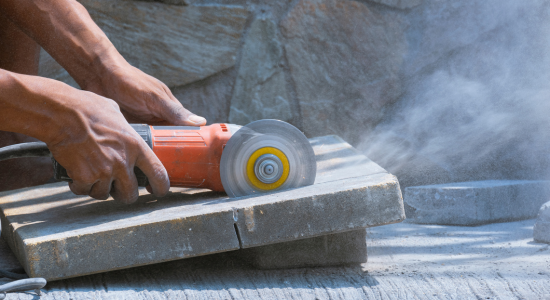
In response to the increased number of deaths of young workers due to silicosis, in May 2026 the Health and Safety Executive (HSE) announced new guidance and enforcement procedures dealing with engineered stone cutting. Although there is no specific law outlawing this activity, the HSE now considers dry cutting as “unacceptable”. This means that the HSE will now focus on it more closely and deal with it more rigorously under the Control of Substances Hazardous to Health Regulations (COSHH).
Silicosis (Respirable Crystalline Silica (RCS)) is a deadly but preventable lung disease caused by inhaling silica dust/particles which become airborne during, or as a result of, dry cutting of stone. Dry cutting methods generate 5–10 times higher exposure. In addition to adequate ventilation and extraction systems, businesses are now expected to use wet cutting/water suppressants to minimise the impact.
The new campaign includes updated guidance notes and treats dry cutting as “unacceptable”, with water suppression (wet cutting) techniques now considered a mandatory requirement to comply with COSHH. The campaign will be enforced rigorously and will be backed up with increased inspections. HSE inspectors are expected to conduct more than 1,000 visits to fabricators, construction sites, and woodworking sites using natural stone, e.g. kitchen worktop manufacturers using quartz or granite.
In addition to the general duties under the Health and Safety at Work Act 1974 and the COSHH Regulations, the guidance notes specifically deal with engineered stone and state that employers MUST:
Assess the risks from RCS.
Switch to stones with low silica content.
Use on-tool water suppression (continuous water supply at the point of generation).
Where possible, provide enclosures where cutting is carried out.
Adopt adequate dust containment systems and control airborne particles, mists, and debris using suitable ventilation systems.
Provide respiratory protective equipment (RPE) suitable for high silica exposure, together with other PPE such as eye protection, protective clothing, and gloves where necessary.
Provide face-fitting tests to ensure effectiveness.
Carry out regular health surveillance.
Prevent or minimise exposure so far as is reasonably practicable.
Where possible, provide off-site pre-fabrication.
Automate cutting processes where possible.
Where possible, avoid handheld uncontrolled processes.
Avoid dry sweeping of dust from floors or surfaces.
Provide health surveillance where exposure to dust risks arises, including lung testing for RCS and Chronic Obstructive Pulmonary Disease (COPD).
In addition to the above, employers are required to inform and train their staff about the risks associated with their activities and the control measures implemented. Such information and training must be reviewed and refreshed regularly. Employers should also review the effectiveness of their measures using air monitoring procedures.
With increased inspections, there is a greater likelihood that non-compliance will lead to:
Improvement Notices – essentially a notice to improve a process, design, or method within a set time.
Prohibition Notices – to stop an activity or equipment, more specifically dry cutting.
Prosecution in more serious cases and against repeat offenders.
Conclusion
The clear message is to eliminate dry cutting, use wet cutting, control dusts and mists, provide suitable PPE, train staff, enforce procedures, provide health surveillance, and monitor effectiveness.
The Health and Safety Advice Line is available on 01455 852 028 to advise you to ensure you are, and remain, compliant. Failures can lead to prosecutions, but more importantly, can lead to untreatable health conditions, fatalities, impacts on wider families, and an increased burden on the NHS and the economy.
More information can be obtained by following the links below.